
Bed bugs love to hide and surprise, don’t they? As tiny but persistent travelers of the pest world, they can appear out of nowhere. It’s important to know where they hide. Do they only stick to mattresses? Nope — they’re not that modest.
You might have a lot of questions about them racing through your mind.
A common one is, Can bed bugs live in your hair or crawl through your scalp? The simple answer is no. But, of course, there’s always a “but.” What if they somehow end up in your hair? What should you do? When should you hire a bed bug control service? Many thoughts might be swirling around. Let’s answer all of these questions you have.
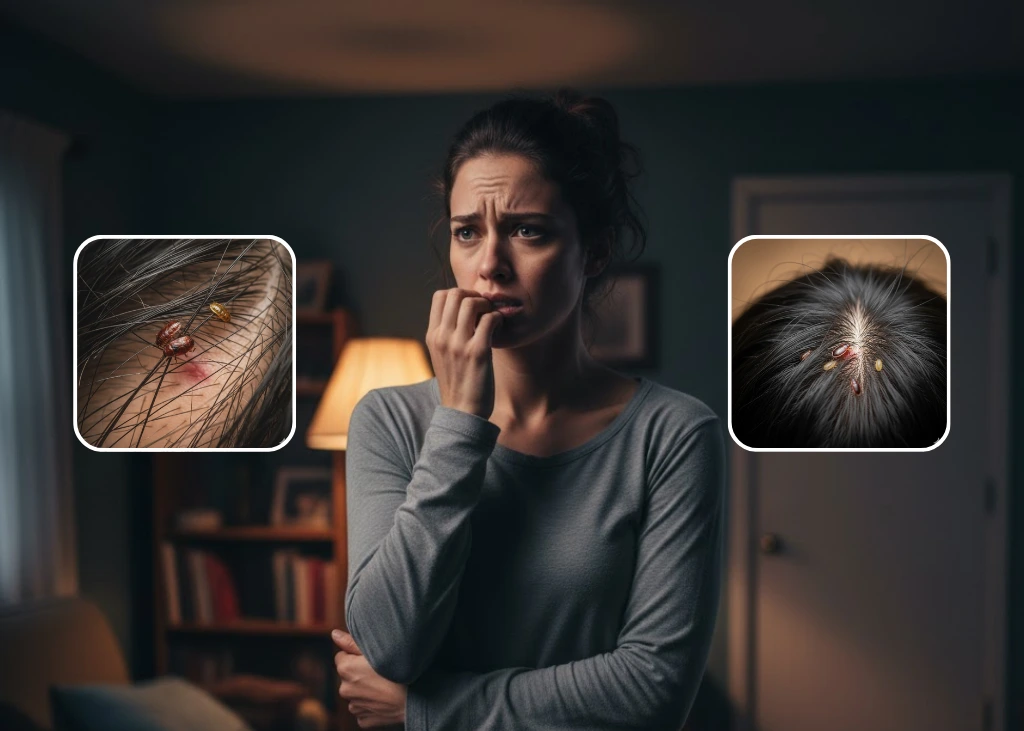
Bed bugs vs Lice: Key differences
Got a crawling feeling and immediately thought, “Bed bugs!”? Hold on a second. Have you seen any other clues of bed bugs nearby? It might not be a bed bug — maybe it’s just a tactile hallucination. If you’re experiencing that itchy feeling several times, it could be head lice instead.
Here are the key differences between bed bugs and head lice:
| Key Features | Bed Bugs | Head Lice |
| Body Shape | Flat and oval-shaped body. | Oblong, Smaller than bed bugs |
| Size | ~4–7 mm | ~2–3 mm |
| Body Color | Reddish Brown | Blackish or Grayish Brown |
| Gripping anatomy | No special claws; crawl on smooth, flat surfaces | Claw-like, crab-shaped claws allow them to cling to hair and move within hair |
| Habitat | Hidden near hosts—mattress seams, pillows, cracks, cloth hems | Entirely on the human scalp and hair |
| Movement | Crawl along flat surfaces and bare skin | Crawl mainly along hair shafts |
| Resistance to washing and shampooing | Not resistant; shampoo or hot water can remove them | Resistant to hot water, blow drying, and shampooing |
Can bed bugs live in your hair?
Human hair is not a pleasant environment for bed bugs. As licensed pest professionals, we can guarantee that bed bugs neither live in nor desire to live in your hair. They simply don’t find hair suitable. Unlike lice, bed bugs lack the crab-like legs that enable crawling and gripping onto surfaces. As a result, they are poor at gripping. Additionally, human hair doesn’t provide flat, clean surfaces; instead, it resembles a dense forest—acting as a natural deterrent for bed bugs, not a habitat.
Just as a penguin can’t fly but swims well because of its body structure. In the same way, bed bugs can’t crawl into hair easily, nor do they cling to the shafts. Although there’s a slight chance they might crawl into a braid or a hairline. It’s likely just a passing visit or a mistake; they don’t live there.
Why do bed bugs avoid living in hair or scalp?
Bed bugs don’t live on human hair or scalp. Is it simply because they don’t like it? Not exactly. Here’s why bed bugs tend to avoid crawling into hair or on the scalp:
1. Lack of Gripping Ability:
Unlike lice, bed bugs don’t have pincers. They also lack crab-like legs; their legs are small and designed for crawling only on flat surfaces. For example, bed bugs can live or travel in clothes. But their structures are not suitable for clinging to hair strands or navigating through dense hair.
2. Heat and Light Exposure:
The scalp can be too hot due to body heat or sun exposure. Additionally, light exposure is high in this area, which bed bugs tend to avoid. As nocturnal creatures, they prefer dark, cool, tight crevices or seams to hide in—places like bedding or furniture, not hair or scalp.
3. Sensitivity to Hygiene Activities:
Bed bugs are easily washed away during bathing, especially with lukewarm water. Human grooming activities—like combing, blow-drying, or shampooing—further eliminate any bed bugs that might have been in the hair.
4. Defense Mechanism:
Hair and scalp are connected to nerve endings, making the human host highly sensitive. When bed bugs crawl, the host often detects the movement quickly. Plus, humans can use their hands to locate and brush off any crawling bugs.
5. Constant Movement:
Hair is constantly in motion due to brushing, shampooing, blow-drying, or even just flipping your head. This instability makes it an unsuitable place for bed bugs to settle.
When can bed bugs lurk in your hair?
Typically, bed bugs avoid crawling on hair or the scalp—that’s just a bed bug thing. Still, you can’t completely rule out the chances. Bed bugs can end up in hair, though it’s rare. They can stay in your hair from a few minutes up to several hours. So, when might you discover bed bugs in your hair? Here are some scenarios:
- A severe infestation where your mattress, pillows, and clothes are heavily infested.
- If bed bugs mistakenly crawl into your ear, hair, or hairline because it’s exposed.
- When they come through your neck area and get caught in your hair.
- After feeding, they might walk through your hair or along your hairline to go back to hiding spots.
- They may also feed on your exposed scalp or hairline.
What to do if you suspect or find bed bugs in your hair?
If you suspect bed bugs in your hair, using a fine-toothed hairbrush can help remove them. However, finding bed bugs in your hair might indicate a severe infestation. Before panicking, here’s what you should do:
- Wash, Comb, and Blow Dry: Remove any visible bugs and wash your hair with hot water. Use your regular shampoo during the shower. Then, blow-dry your hair on high heat (above 113°F/45°C) to kill remaining bugs.
- Inspect Your Entire Home: Thoroughly check mattresses, wall cracks, furniture, wardrobes, pillows, and clothes for signs of bed bugs.
- Wash, Vacuum, and Declutter: Wash all clothing, bedding, mattress, and pillow covers. Vacuum thoroughly and clear clutter to reduce hiding spots.
- Seek Professional Help: If DIY methods aren’t enough, hire a pest control expert to eliminate the infestation effectively.
Final Words:
Can bed bugs live in your hair? Most likely not, unless the infestation is really bad. Bed bugs dislike hair and are more likely to be found in beds, furniture, or clothes. Keep an eye out for formication — the sensation of bugs crawling on your skin — which is common when people are anxious about pests.
Don’t let the fear take over. Hire a professional pest control service to get rid of them once and for all.
FAQ About Bed Bugs Habitat in Hair or Scalp
Why does it feel like bugs in my hair but nothing’s there?
This sensation, known as tactile hallucination or formication, occurs when you feel bugs that aren’t there. It can be linked to neurological or mental health issues, so consulting a healthcare professional is advisable.
Do bed bugs live in clothes?
Bed bugs in clothes? Often found. But they don’t live permanently in clothes; they often hide in them to travel. Think of clothes as their Uber, they use them to move around and hide, especially in dark places like your wardrobe.
Do bed bugs bite every night?
Bed bugs usually feed every 5 to 7 days. If you have a large infestation, you might get bitten more frequently, even nightly, because different bugs have different feeding cycles.
Can you feel a bedbug crawling on you?
Most people can’t feel bed bugs when they crawl or bite because they are too small. Plus, they inject a numbing agent when they bite, so you often don’t notice the crawling or biting.
Can bed bugs live in your pillow?
Absolutely, especially in pillows with holes or tears. Bed bugs tend to hide in the seams of pillows and can sometimes use them as nesting sites or egg-laying spots, although they prefer mattresses.
How do you know if you have bugs in your scalp?
Bugs in your scalp often cause itching and crawling feelings. You might find live bugs, exoskeletons, blood spots, or dark stains on your pillow cover or bedding.
Which bugs live in human hair?
Head lice are the main culprits, living their entire lives on the scalp and hair strands. Mites and ticks can also inhabit the scalp, but they are less common.
Do bed bugs wash off in the shower?
Yes, hot water can wash away bed bugs. These tiny pests can’t cling tightly to your skin or hair, causing them to fall off easily under running water.
How to check your hair for bugs?
Comb your hair thoroughly with a fine-toothed comb. Look for signs like tiny red bites or itchy patches, and closely examine your scalp for bugs.